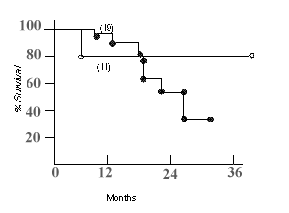
Fig. 1. Actuarial survival of glioblastoma multiforme (black circles) and anaplastic astrocytoma (open circles) patients. Number in parentheses is the number of patients at risk 12 months after diagnosis.
Joint Center for Radiation Therapy, Neurosurgical Service, Brigham and Women’s Hospital and The Children’s Hospital and the Departments of Radiation Oncology and Surgery, Harvard Medical School, Boston, Mass., USA
Reprinted with permission
of the authors
Meyer JL, Vaeth JM (eds): Organ Conservation in Curative Cancer Treatment.
Front Radiat Ther Oncol. Basel, Karger, 1993, vol 27, pp 227-244
Radiosurgery was originally described as a technique to ‘destroy’ intracranial lesions using single high doses of ionizing radiation in stereotactically directed narrow beams. Radiosurgery produces biological affects that range from blood vessel thrombosis to reproductive cell death and frank necrosis within the treatment volume. Radiosurgery is indicated in the treatment of relatively small, radiographically discrete tumors that cannot be completely resected without significant risks, for tumor that cannot be adequately controlled with radiotherapy, and for tumors that have recurred following prior surgical resection and/or radiotherapy.
The different radiosurgical techniques (cyclotrons, gamma units, modified linear accelerators) all share a common goal: to deliver a single high dose of ionizing radiation to a radiographically well-defined, small intracranial target without delivering a significant proportion of the prescribed dose to the surrounding brain tissue. This is particularly important in treating patients with previously irradiated, recurrent tumors. Thus, including a discussion on radiosurgery for CNS malignancies in this Symposium on Organ Conservation in Curative Cancer Treatment is quite appropriate.
While both radiotherapy and radiosurgery involve ionizing radiation, treatments differ in several important physical and biological respects. In general, a large, single fraction of radiation reduces the therapeutic ratio (i.e. the probability of successful therapeutic outcome without producing clinically significant normal tissue injury) versus multifractionated therapy. However, when the treatment volume is small and contains little functioning brain tissue, the assumption of fractionated radiation is less compelling. Attempts have been made to document dose-volume relationships for single fraction radiotherapy. The relationship between dose and volume is linear on a log-log plot and clearly shows the need to reduce the total dose of radiation delivered as the treatment volume increases [1]. This relationship is important to understand when treating malignant lesions with radiosurgery; namely, the larger the tumor volume, the lower the dose that can be safely delivered - thus lowering the probability of tumor control. It is unrealistic to expect radiosurgery to play a major role in the curative treatment of any large CNS malignancy, whether primary or metastatic.
Radiosurgery is now a well-established therapy in the treatment of small, inoperable arteriovenous malformations and radiographically distinct, histologically benign intracranial tumors. However, the role of radiosurgery in the treatment of malignant tumors is less established. We would like to limit our discussion for this Symposium to the role of radiosurgery in the treatment of metastases and newly diagnosed malignant gliomas. We will emphasize our 5-year radiosurgical experience with malignant tumors using a modified 6-MV linear accelerator at the Brigham and Women’s Hospital/Joint Center for Radiation Therapy, Boston, Mass., USA.
Patients were followed by enhanced CT or MRI scanning and neurological examination 6 weeks following radiosurgery and every three months thereafter. Corticosteroids were prescribed only if patients demonstrated clinical and radiographic evidence of significant cerebral edema.
Institution	RS	Lesions	Dose	% local	FU, months
                        treated	cGy	control

Harvard 	LA	239	1,650	94	9
Heidelberg	LA	124	1,700	94	7
Wisconsin [13]  LA      45      1,800   73      8.5
Pittsburgh	GU	40	1,600	95	6
Karolinska	GU	59	3,000	98	NS
RS = Radiation Source; LA
= linear accelerator; GU = gamma unit; Dose = median peripheral dose; FU = median
follow-up in months. Data from Heidelberg, Pittsburgh, and the Karolinska were
reported at the International Stereotactic Radiosurgery Symposium, June 19-21,
1991, Pittsburgh, Pa., USA.
Seven additional patients have failed at the immediate field edge of the sharp-dose gradient of the radiosurgery field. The interval from radiosurgery to these marginal failure was 5 months (range 4-9 months). Two of these marginal failure patients (adenocarcinoma of the lung and choriocarcinoma) were treated with further surgery; 2 patients (adenocarcinoma of the colon and lung) were retreated with radiosurgery to the new area of disease. Fifty-one of 167 (30%) of our patients have developed either new brain lesions or carcinomatous meningitis 1-27 months following radiosurgery. Of note, 6/12 patients who refused whole brain radiotherapy initially have relapsed with new CNS disease and have gone on to receive whole brain radiotherapy. Fifty- six patients have died since being treated with radiosurgery. The cause of death in these 56 patients was attributed to progressive systemic disease in 26 patients, progressive CNS disease in 24 patients, and both progressive CNS and systemic disease in 6 patients. The median survival for the 167 patients treated is 9 months (range 1-69 months). in summary, 226/239 (94%) of the metastatic tumors treated with radiosurgery have been controlled with a median follow- up period of 9 months. The development of progressive systemic disease was the major cause of death in our patients.
Neurological improvement was seen in the majority of patients treated with radiosurgery within the first 3 months of therapy. Clinical signs of increased intracranial pressure (headache, nausea, vomiting, lethargy) were reduced or eliminated within 3 months of treatment in 70% of patients. These patients have been successfully withdrawn from corticosteroid therapy.
We have previously published that the radiographic response to radiosurgery is very dependent on the histology of the primary disease and volume of the metastasis [8]. In general, responses have been rapid and dramatic in adenocarcinomas, squamous cell carcinomas, small cell carcinomas, and germ cell tumors. Melanomas, sarcomas, and renal cell carcinomas have either radiographically decreased slightly over time or have stabilized with the development of a new central region of hypodensity. Despite these generalizations it should be stressed that we have observed heterogeneous response patterns when evaluating response. Larger lesions (tumor volumes > 10 cm3) respond less quickly than smaller lesions. In part, this is a dose- related phenomenon since larger lesions receive lower doses compared to smaller lesions.
Nausea and/or vomiting has occurred in 15 patients within 12 h of radiosurgery. All but 1 of these patients had a metastasis within a few millimeters of the floor of the fourth ventricle (area postrema). The incidence and severity of these symptoms were directly correlated to the dose delivered to the area postrema (vomiting center) [9]. All patients who received >275 cGy (range 275-1,340 cGy) to the area postrema developed these symptoms. Only 5 patients have developed repeated episodes of nausea and vomiting more than 12 h following radiosurgery. We routinely premedicate patients with corticosteroids and antiemetic therapy 4-6h prior to radiosurgery if the calculated total dose to the area postrema will be significant. The use of premedication has significantly reduced the incidence and severity of these symptoms.
Two patients treated for lesions in the motor cortex have developed weakness 2 and 36h after radiosurgery, respectively. In both patients the weakness completely resolved within 36h of onset without the administration of corticosteroids. Permanent hemiparesis had not developed in any patient treated for an asymptomatic metastatic lesion in the motor cortex.
Eleven patients had complete disappearance or dramatic reduction (>75%) of the enhancing lesion on repeated enhanced CT at 3 months and were successfully withdrawn from corticosteroid therapy. Between 3.5 and 13 months, however, these patients developed edema and a small ring enhancing lesion corresponding to the region treated with radiosurgery. The etiology of the residual radiographic abnormality is not completely understood, but is believed to be related to transient effects of large, single doses of radiation upon vascular permeability. Three months after radiosurgery, we have stereotactically biopsied 1 patient with this new enhancement and found tumor necrosis with laminated calcification and fibrinoid necrosis of small vessels. Recognition of this development in the patient treated with radiosurgery is important since it will reduce unnecessary patient and physician concern or initiation of additional intervention [10].
One patient (melanoma lesion of the cerebellum) developed sudden neurological deterioration 2 weeks after radiosurgery and on CT scanning had an intralesional bleed. This patient was taken to the operating room and had the hematoma removed. Pathology revealed only scattered melanoma cells remaining even though the radiosurgery was only 2 weeks prior. This is the only posttreatment bleed we have encountered in patients treated with radiosurgery for metastases.
We have seen two forms of chronic radiation injury as a result of radiosurgery in our patients. One injury is symptomatic radiation necrosis while the other is cranial nerve dysfunction. Four patients have undergone reoperation for the development of symptomatic radiation necrosis 1, 9, 12, and 20 months following radiosurgery respectively. Three of the 4 patients could not be successfully withdrawn from corticosteroid support postoperatively and had slight increase in the size of the enhancing mass in the radiosurgery treatment volume. One patient treated for a multiply recurring gastric carcinoma metastasis developed clinical signs of increased edema and was reoperated on at an outside institution 1 month following radiosurgery because of concerns of recurrence. Necrosis and persistent tumor were found. At the time of reoperation in the remaining 3 patients, well-demarcated necrotic lesions were found that corresponded to the radiosurgery volume treated. Of interest, in 2 of these 3 patients a few residual tumor cells were seen within the central region of the necrotic areas. It is not clear why these patients have developed symptomatic radiation necrosis. The dose and volume treated with radiosurgery were similar to our other patients who have not developed symptomatic radiation necrosis. All 4 patients, however, received prolonged courses of intravenous methotrexate as part of their primary tumor therapy. We postulate that prior exposure to methotrexate may have made these patients more susceptible to radiation injury by radiosurgery.
Two patients have developed permanent cranial neuropathies 7 and 8 months following radiosurgery, respectively. Both patients were treated fro recurrent, previously irradiated lesions near the pons (cerebellar pontine angle and Meckel’s cave). One patient has developed progressive hearing loss in one ear and the other patient has developed a fifth nerve hypoesthesia that has not responded to corticosteroid therapy. The doses to the eighth and fifth cranial nerves in these 2 cases were 1,500 and 1,650 cGy, respectively, in addition to the previous whole brain irradiation.
Sturm et al. [11] first reported the results of radiosurgery using a linear accelerator for the treatment of brain metastases, and in a later report from the same institution, 37 patients were treated and followed for an average of 6.8 months [12]. After doses of 2,500-3,000 cGy, only 2 patients progressed within the radiosurgery volume and 84% of patients improved clinically. A recent report from the University of Wisconsin describes their experience in treating 45 lesions in 33 patients [13]. Delivering a median minimal dose of 1,800 cGy, 36% had a CT-defined complete response by 3 months and 30% achieved a partial response (>50% volume reduction). Only 1 of 16 patients achieving a complete response ever failed locally - demonstrating the durability of the radiosurgery response. A time-volume scattergram of these data demonstrates that most response occur in lesions >10 cm3, usually within the first 3 months posttreatment. The University of Pittsburgh recently published their results concerning 24 patients treated with the gamma unit for newly diagnosed metastatic disease (21) or recurrent disease (3) [14]. After marginal doses of 1,660 cGy (median), only 1 patient failed within the radiosurgery field 5 months after treatment and was salvaged with surgery. The majority of their patients either improved or remained neurologically stable after radiosurgery. A summary of the results of radiosurgery using various techniques in the treatment of brain metastases is included in table 3.
In comparison to surgical resection, radiosurgery has several attractive features in the treatment of brain metastases including brief or no hospital stay, no risk of bleeding, infection or wound complications. These are all very important features in the management of patients often heavily pretreated for systemic cancer and having limited life expectancy. Recently, a collaborative study has begun between the Joint Center for Radiation Therapy in Boston and University of California, San Francisco in an attempt to determine if radiosurgery can produce equivalent results to surgery in the management of patients with single metastatic lesions. The details of this study have been previously published.
Studies of radiation dose-response relationships using conventional external beam techniques have failed to show improved local tumor control or survival with escalations of dose beyond 60 Gy in 6 weeks [17, 18]. On the other hand, The ability of stereotactic brachytherapy to enhance local disease control has been demonstrated [19]. Furthermore, uncontrolled prospective studies have suggested that this improved local control results in significantly improved survival among appropriately selected patients. Brachytherapy permits much greater escalation of radiation dose within a well-defined volume than is possible with traditional external beam techniques. unfortunately, even in patients with radiographically well-defined tumors, the potential risks of the implant procedure in patients with coexisting serious medical illness or tumors located in relatively inaccessible or eloquent regions of the brain may be unacceptable.
Between May 1988 and May 1991 we treated 80 patients with malignant gliomas (43 recurrent, 37 newly diagnosed). We will limit our discussion to those 37 patients treated for newly diagnosed disease. There were 20 males and 17 females ranging in age from 14 to 84 years (median 50 years). The median KPS at the time of diagnosis was 85% (range 70-100%). Twenty-three patients (62%) had a histologic diagnosis of glioblastoma multiforme while 14/37 patients (38%) had anaplastic astrocytomas. Tumors were predominately frontal in 15 (41%) patients, temporal in 4 (11%), parietal in 3 (8%), and occipital in 2 (5%). Twelve (33%) had tumors located in the thalamus, corpus callosum, or other central structures, and 1 (3%) patient had an infratentorial lesion. In all but 5 of these patients, the use of brachytherapy as a boost technique was rules out because of tumor location. Brachytherapy was refused by 2 patients, 1 or whom had suffered an intracranial hemorrhage during an attempted high-activity 125I implant. Brachytherapy was considered contraindicated in 3 cases because of coexisting medical illness.
Characteristic	                 Metastases	Gliomas
Reduction of enhancing volume	  common        unusual
Enlargement of enhancing volume	  unusual       common
Increased neurological deficit	  rare          common
Reoperation for necrosis	  rare          unusual
Steroid dependency	          unusual       common
Marginal relapse	          rare          common
Fig. 1. Actuarial survival of glioblastoma multiforme (black circles) and anaplastic
astrocytoma (open circles) patients. Number in parentheses is the number of
patients at risk 12 months after diagnosis.
Among patients with glioblastoma multiforme, 16/23 (70%) remain alive and 15/23 (65%) are alive and disease- free. Four patients with glioblastoma suffered failures at the margins of the radiosurgery volume and died 13-27 months after diagnosis. Two patients progressed locally within the radiosurgery volume and died. Another glioblastoma patient who died had developed progressive neurologic symptoms with increasing mass effect on CT scan. Reoperation at another institution revealed only necrotic tissue, but his condition continued to deteriorate and he died 18 months after diagnosis. Postmortem examination was not done and death was attributed to radiation injury. Of the 19 patients in the glioblastoma group at risk a year or more after treatment, 18 are without evidence of progressive disease. One patient is alive with local and marginal recurrence 16 months after diagnosis.
We have previously described several treatment-related variables associated with neurological complications following radiosurgery for gliomas [20]. Nedzi et al. [20] studied several variables in a logistic model. Those associated with toxicity (in a univariate score test from a logistic model) were: tumor dose inhomogeneity; maximum tumor dose; number of isocenters; maximum dose normal tissue dose, and tumor volume. Maximum tumor dose and tumor volume plotted on a log-log scale illustrate the association of complication with both higher maximum tumor doses and larger tumor volumes, and provide a distribution of tumor volumes and maximum doses for the patients included in this analysis. We concluded that maximum dose and dose inhomogeneity within tumors treated with radiosurgery are important variables associated with complications.
Selection bias significantly contributes to our improved survival rates compared to historical controls. It is clear that most of our patients fall into a relatively favorable prognostic subset because of small tumor size. A recent study showed that patients with malignant gliomas treated with conventional radiosurgery for small, radiographically distinct tumors have a median survival (16.7 months) that is almost twice that which is seen in patients with large diffuse tumors (9.3 months, p = 0.004) [23].
Stereotactic brachytherapy may substantially improve survival when used as a boost technique during the initial treatment of selected patients with malignant gliomas. We previously reported our results using high activity 125I sources to treat 35 patients with glioblastoma multiforme [20]. These patients obtained a median survival of 27 months compared to a median survival of only 11 months in a group of patients with similar survival characteristics studied retrospectively. The median survival (27 month) for glioblastoma patients boosted with brachytherapy from the above study is similar to the median survival (26 months) for glioblastoma patients boosted with radiosurgery in this current study. However, differences in tumor volume and location between patients in the brachytherapy and radiosurgery studies confound efforts to compare results. Notwithstanding the difficulties in assessing the efficacy of radiosurgery in terms of survival, it is encouraging to note that with a median follow-up of 19 months, only 9 patients have died, and only 6 deaths could be attributed to recurrent tumor.
Seven of 37 (19%) of patients in this series eventually required reoperation for increasing mass effects. With the possible exception of tumor histology, we have been unable to detect any factors predicting the need for reoperation. Tumor volume correlated strongly with the need for reoperation in patients treated initially with brachytherapy [18], but no such relationship was observed in this study. It is not clear why such a high percentage of these patients required a reoperation for symptomatic necrosis. Of interest, the treatment volumes and doses of radiation used in patients with malignant gliomas were very similar to those used for the metastatic patients. It appears that while dose and volume are important factors associated with the development of symptomatic radiation necrosis, the underlying pathology of the area treated is also an important variable.
2. Posner J: Management of central nervous system metastases. Semin Oncol 1977; 4:81-91.
3. Cairncross JG, Kim JH, Posner JB: Radiation therapy for brain metastases. Ann Neurol 1980; 7:529- 541.
4. Patchell RA, Tibbs PA, Walsh JW, et al: A randomized trial of surgery in the treatment of single metastases to the brain. N Engl J Med 1990; 322:494-500.
5. Lutz W, Winston KR, Maleki N: A system for stereotactic radiosurgery using a standard linear accelerator. Int J Radiat Oncol Biol Phy 1988; 14:373-381.
6 Kooy HM, Nedzi L, Loeffler JS, et al: Treatment planning for stereotactic radiosurgery of intra-cranial lesions. Int J Radiat Oncol Biol Phy 1991; 21:683-693.
7. Tsai JS, Buck BA, Svensson GK, et al: Quality assurance in stereotactic radiosurgery using a standard linear accelerator. Int J Radiat Oncol Biol Phy 1991; 21:737-748.
8. Loeffler JS, Kooy HM, Wen PY, et al: The treatment of recurrent brain metastases with stereotactic radiosurgery. J Clin Oncol 1990; 8:576-582.
9. Alexander, E III, Siddon RI, Loeffler JS: The acute onset of nausea and vomiting following stereotactic radiosurgery: Correlation with total dose to area postrema. Surg Neurol 1989; 32:40-44.
10.Loeffler JS, Siddon RI, Wen PY, Alexander, E III: Stereotactic radiosurgery suing a standard linear accelerator: A study of early and late effects. Radiother Oncol 1990; 17:311-321.
11. Sturm V, Kober B, Hover KH, et al: Stereotactic percutaneous single dose irradiation of brain metastases with a linear accelerator. Int J Radiat Oncol Biol Phys 1987; 13:279- 282.
12. Engenhart R, Kimmig B. Sturm, V: Stereotactically guided convergent beam irradiation of solitary brain metastases and cerebral arteriovenous malformations; in Dyck P, Bouzaglou A (eds): Brachytherapy of Brain Tumors and Related Stereotactic Treatment. Philadelphia, Hanley & Belfus, Inc, 1989, pp 119-132.
13. Mehta M, Mackie TR, Levin AB, Gehring MA, Kubsad SS, Rozental JM, Kinsella TJ: Radiosurgery for brain metastases. Contemp Oncol 1991; 5:12-19.
14. Coffey RJ, Flickinger JL, Bissonette DJ, Lunsford LD: Radiosurgery for solitary brain metastases using the cobalt-60 gamma unit: Methods and results in 24 patients. Int J Radiat Oncol Biol Phy 1991; 20:1287-1295.
15. Loeffler JS, Alexander, E III, Kooy HM, et al: Radiosurgery for Brain Metastases; in DeVita VT, Hellman S, Rosenberg SA (eds): Cancer: Principles adn Practice of Oncology, Update. Philadelphia, Lippincott, 1991, vol 5, pp 1-13.
16. Kelly PJ, Daumas-Duport C, Kispert DB, et al: Imaging-based stereotaxic serial biopsies in untreated intracranial glial neoplasms. J Neurosurg 1987; 66:865-874.
17. Walker MD, Strike TA, Sheline GE: An analysis of dose-effect relationship in the radiotherapy of malignant gliomas. Int J Radiat Oncol Biol Phy 1979; 5:1725-1731.
18. Chang CH, Horton J, Schoenfeld D, et al: Comparison of postoperative radiotherapy and combined postoperative radiotherapy and chemotherapy in the multidisciplinary management of malignant gliomas: A joint Radiation Therapy Oncology Group and Eastern Cooperative Oncology Group Study. Cancer 1983; 52:997-1007.
19. Loeffler JS, Alexander, E III, Hochberg FH, et al: Clinical patterns of failure following stereotactic interstitial irradiation in malignant gliomas. Int J Radiat Oncol Biol Phys 1990; 19:1455-1462.
20. Nedzi L, Kooy HM, Alexander, E III, Gelman RS, Loeffler JS; Variables associated with the development of complications from radiosurgery of intracranial tumors. Int J Radiat Oncol Biol Phys 1991; 21:591-599.
21. Loeffler JS, Alexander, E III, Shea WM: Results of stereotactic brachytherapy used in the initial management of patients with glioblastoma. J Natl Cancer Inst 1990; 82:1981- 1921.
22. Gutin PH, Prados MD, Phillips TL, et al: External irradiation by an interstitial high activity iodine-125 implant ‘boost’ in the initial treatment of malignant gliomas: NCOG study 6G- 82-2. Int J Radiat Oncol Biol Phys 1991; 21:601-606.
23. Florell RC, MacDonald DR, Irish WD et al: Selection bias, survival, and brachytherapy for glioma. J Neurosurg 1992; 76:179-183.
Jay S. Loeffler, MD, Joint Center for Radiation Therapy, Department of Radiation Oncology, Harvard Medical School, Boston, MA 02115 (USA)
(Transcibed by J. Cipielewski, 7-19-94)